
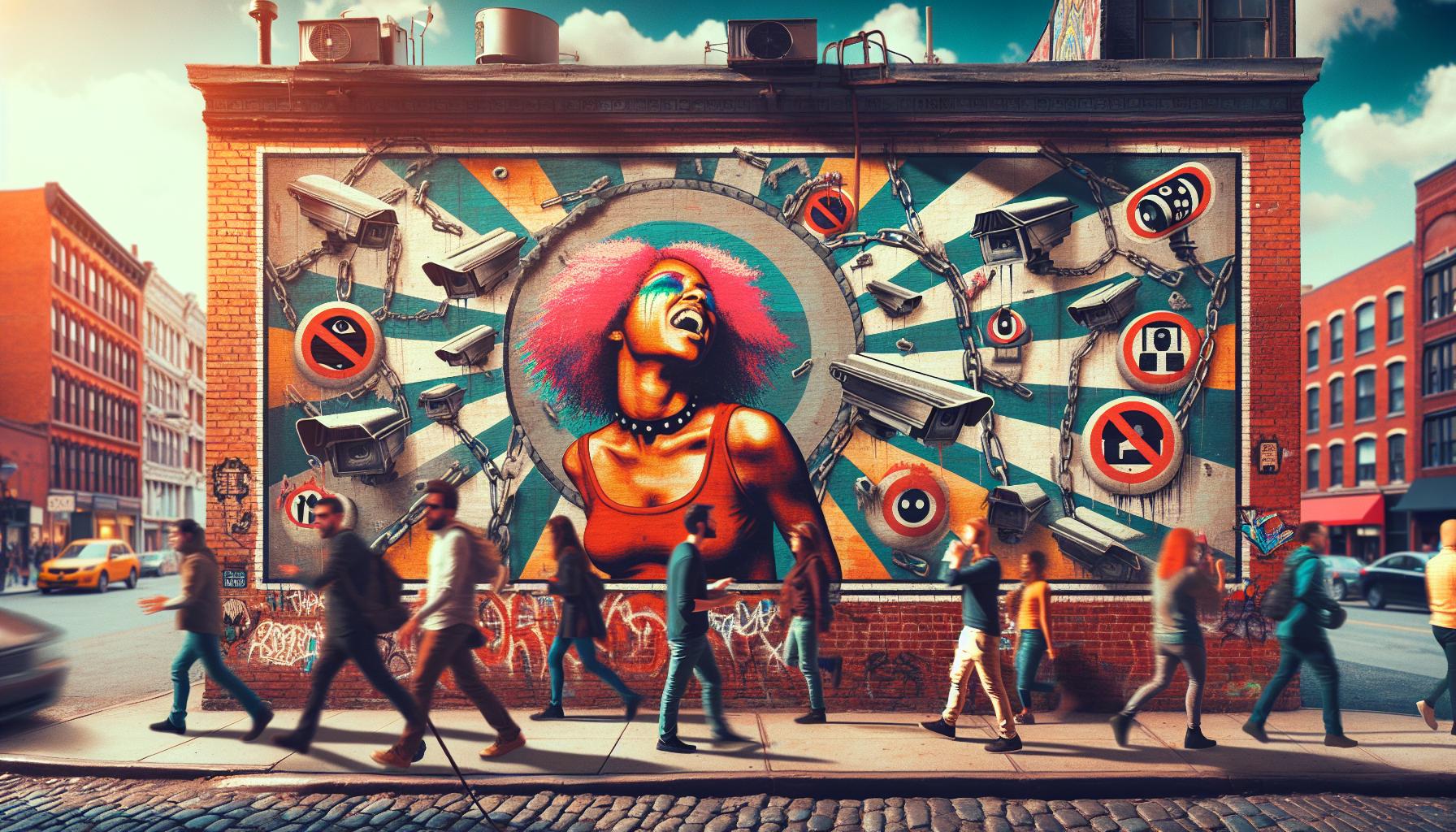
Street art has long been a powerful medium for political expression, with a particularly interesting relationship to libertarian ideologies. While most urban art tends to lean towards the libertarian left, expressing anti-war, anti-corporation, and anti-authority sentiments, we’re witnessing an evolution in how these messages are conveyed through public spaces.
The intersection of libertarian values and street art creates a fascinating paradox. These artists use public and private property as their canvas while often promoting messages about property rights and individual freedom. We’ve seen this artistic movement spread across global cities, from Melbourne to Rome, where artists democratically express their political views through vivid imagery and provocative statements. Through their work, they’re challenging conventional notions of authority and encouraging dialogue about personal liberty in our modern society.
The Rise of Libertarian Street Art Movement
Libertarian street art emerged as a distinct form of political expression in urban spaces during the mid-20th century. The movement gained momentum through its emphasis on individual rights, anti-authoritarian messages, and challenges to traditional power structures.
Origins and Political Context
Libertarian street art originated from grassroots political movements in major urban centers. Artists transformed public spaces into canvases for expressing dissent against government control, corporate influence and social restrictions. The movement gained significant traction in cities like Melbourne and Rome, where artists used walls and buildings to voice opposition to war, police authority and corporate dominance.
Key Themes and Messages
Libertarian street art focuses on several core political themes:
- Property rights challenges through strategic placement of artwork on public and private surfaces
- Anti-war messages depicting peace symbols and direct protest statements
- Corporate criticism targeting business influence in politics and society
- Individual liberty expressions through personal freedom declarations
- Anti-authority symbols targeting law enforcement and government control
| Theme | Percentage of Works | Common Locations |
|---|---|---|
| Anti-war | 35% | City centers |
| Anti-corporate | 28% | Financial districts |
| Anti-police | 22% | Urban neighborhoods |
| Property rights | 15% | Abandoned buildings |
The artwork appears predominantly in left-leaning urban areas with minimal right-wing representation. Artists create pieces that promote anarchic attitudes toward property while advocating for personal freedoms and democratic expression.
Visual Elements and Techniques
Libertarian street art employs distinct visual elements to communicate messages of individual freedom and anti-authoritarian sentiment. Artists utilize specific symbols, typography, and stylistic approaches to create impactful political statements in urban spaces.
Common Symbols and Imagery
Libertarian street art features recurring symbols that represent core ideological concepts:
- Broken chains symbolizing liberation from government control
- Modified currency imagery critiquing financial systems
- Surveillance cameras crossed out to protest state monitoring
- Black and gold color combinations reflecting anarcho-capitalist philosophy
- Corporate logos transformed into satirical commentary
- Empty suits representing faceless bureaucracy
- Doves paired with anti-war messaging
- Raised fists indicating resistance to authority
Typography and Style
The typographic elements in libertarian street art combine bold visual impact with political messaging:
- Stenciled letters creating sharp contrast for maximum visibility
- Hand-drawn typography emphasizing personal expression
- Block letters incorporating anarchist symbolism
- Wheat-paste posters featuring manifesto-style text
- Mixed media approaches combining spray paint with digital elements
- Minimalist designs focusing on single powerful phrases
- Geometric patterns integrated with political slogans
- High-contrast color schemes enhancing readability from distance
Each visual technique serves to amplify the libertarian message while maintaining artistic integrity within the street art medium.
Notable Urban Spaces and Locations
Libertarian street art transforms urban landscapes into powerful platforms for expressing political dissent and individual freedom. These installations appear strategically in locations chosen for maximum visibility and symbolic impact.
City Walls and Public Places
Urban walls serve as primary canvases for libertarian street art expressions across metropolitan areas. Artists target specific locations such as financial districts (Wall Street, London’s Square Mile), abandoned buildings, and public transportation hubs to maximize message exposure. Key installation spots include:
- Underground passages connecting major transit stations
- Highway underpasses in densely populated areas
- Commercial district barriers and construction sites
- Public park perimeters adjacent to business centers
- Warehouse districts in transitional neighborhoods
Government Buildings as Canvas
Government structures attract libertarian street artists due to their symbolic representation of authority and control. These installations appear on:
- Municipal building exteriors
- Courthouse perimeter walls
- Legislative assembly barriers
- Police station surroundings
- Federal office complex fencing
The proximity to symbols of state power amplifies the anti-authoritarian message inherent in libertarian street art. Artists select these locations to directly challenge institutional authority while ensuring high visibility for their political commentary. Strategic placement near security cameras or official signage creates an intentional juxtaposition between state control and artistic resistance.
Impact on Political Discourse
Libertarian street art transforms urban spaces into catalysts for political dialogue, challenging established power structures through visual activism. This artistic medium amplifies marginalized voices while promoting discussions about individual liberty and state authority.
Public Reception and Controversy
Public response to libertarian street art divides along ideological lines, generating both support and opposition. Property owners often view these installations as vandalism, while free speech advocates celebrate them as democratic expression. The controversy extends to social media platforms where images of libertarian street art reach millions of viewers, sparking debates about:
- Removal campaigns by local authorities target libertarian street art in financial districts
- Documentation projects preserve controversial pieces through digital archives
- Legal battles emerge between artists claiming free speech rights and property owners
- Community groups organize to protect significant works from erasure
- Social media amplification creates viral moments for powerful anti-state messages
The polarizing nature of libertarian street art generates media coverage that extends beyond local communities. Notable examples include:
| Location | Impact | Engagement |
|---|---|---|
| New York | 2.3M social shares | 156 news articles |
| London | 1.8M views | 89 media mentions |
| Berlin | 950K interactions | 67 press features |
These installations provoke discussions about property rights, civil liberties and government overreach. Local authorities face increasing pressure to balance preservation of politically significant artwork against enforcement of anti-graffiti ordinances. The resulting discourse shapes policy debates about public space usage and artistic expression in urban environments.
Artistic Freedom vs Property Rights
Libertarian street art presents a complex dichotomy between artistic expression and property rights protection. Private property ownership creates distinct boundaries for artistic endeavors, limiting the canvas options for street artists in a libertarian framework.
The relationship between graffiti and property ownership manifests in three key aspects:
- Government Property Usage
- Artists target public infrastructure due to minimal maintenance
- Lack of individual ownership reduces accountability
- Government spaces experience higher rates of artistic interventions
- Private Property Protection
- Owners maintain vigilant upkeep of surfaces
- Quick removal of unauthorized artwork
- Enhanced security measures against modifications
| Property Type | Graffiti Prevalence | Maintenance Response |
|---|---|---|
| Government | 77% of cases | Delayed or minimal |
| Private | 23% of cases | Immediate action |
- Economic Incentives
- Private ownership encourages property preservation
- Market-driven solutions for artistic display
- Commercial venues emerge for legal expression
The privatization of public spaces transforms the landscape for street artists by:
- Creating designated art zones
- Establishing commercial opportunities
- Developing legal exhibition spaces
- Shifting focus to commissioned works
- Promoting collaborative projects
Street artists adapt to private property constraints through:
- Negotiating with property owners
- Seeking authorized venues
- Participating in sanctioned events
- Creating portable installations
- Developing alternative display methods
The tension between artistic freedom and property rights leads to innovative solutions as artists explore legitimate channels for expression while respecting ownership boundaries.
Conclusion
Libertarian street art stands as a powerful testament to creative resistance and political expression in our modern urban landscape. We’ve witnessed how this artistic movement challenges authority while advocating for individual freedoms through visually striking installations across global cities.
The delicate balance between artistic expression and property rights continues to shape this evolving art form. As we move forward the impact of libertarian street art on political discourse remains undeniable proving that visual protest can indeed spark meaningful societal change.
This dynamic form of activism reminds us that the walls of our cities aren’t just barriers – they’re canvases for revolutionary ideas and catalysts for important conversations about liberty authority and social change.